November 17, 2026
The AI Transformation Has Barely Started, and Most Companies Haven't Pictured It Yet
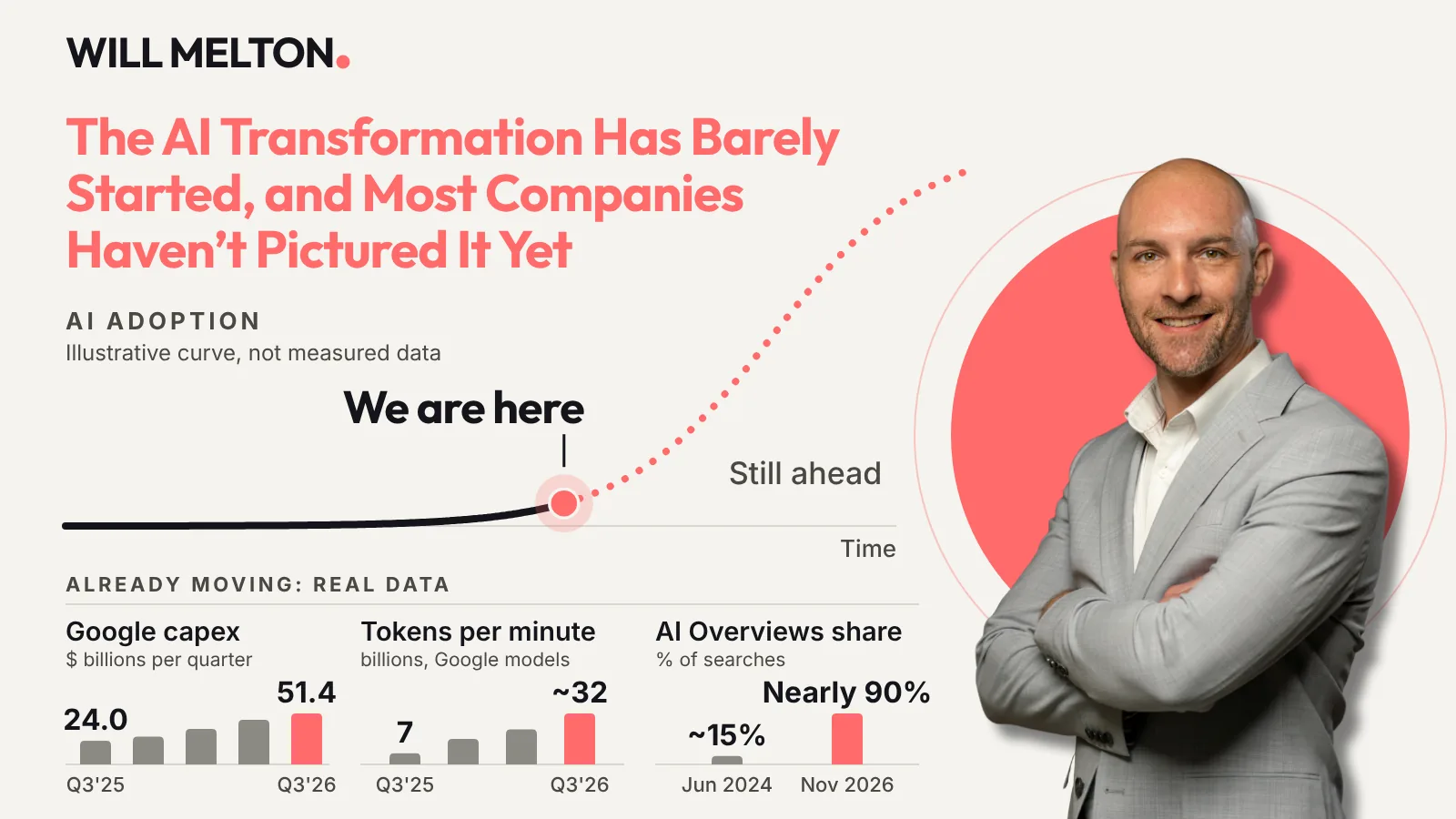
We are early in a transformation that will change how companies and society work, and most of us haven't pictured it yet. Google's earnings call shows what's already being built for it.
Most Companies and Communities Haven't Yet Pictured What the AI Transformation Will Look Like
What's happening right now is nothing shy of transformative. We are in the middle of it, and I think we may be really early in it.
Look at who is already using these tools. Software engineers and developers who have spent years building technology have been newly empowered by them, and they are going to make discoveries and introduce shifts we can't list yet. Alongside them is a whole new class of builders and thinkers who haven't had this kind of leverage before. They are using more AI compute, and the agents they deploy are using it too.
Adoption of a technology follows a curve, and we are barely out of the flat line at the start of it. That's true inside companies, and it's true for individuals as AI assistants that perform tasks for us autonomously keep getting better.
Some of the change is already visible. In June 2024, a few weeks after launch, Google's AI Overviews were showing on around 15% of searches. Today they appear on nearly 90%. (Sources: BrightEdge data via 9to5Google, June 2024; Advanced Web Ranking, November 2026.) Companies are having to respond to that shift in customer behavior to stay visible and keep growing. One picture of what comes next: companies will need websites and systems that can take orders from their customers' AI agents.
I'm not saying this to overwhelm anyone. I'm saying it because it's coming, and the sooner we accept that, the sooner we can start working out the role each of us plays in shaping it.
Google Is Spending More on AI Data Centers Than Its Business Brings In, and Investors Are Asking Whether It's Too Much
On October 28, Google's parent company, Alphabet, told investors it had spent more over the summer than its business brought in. Its operations generated $42.3 billion in cash in three months, and it spent $51.4 billion, most of it on the servers and data centers that run AI. Free cash flow, the cash left after those investments, was negative $9.1 billion. (Source: Alphabet Q3 2026 earnings call.)
It was the second quarter in a row. The first, reported in July, was the first time that number had gone negative since Google went public in 2004. (Source: Tom's Hardware, citing Alphabet's Q2 2026 earnings release.)
Google is not pulling back. It expects to spend $195 billion to $205 billion this year, and significantly more in 2027. (Source: Alphabet Q3 2026 earnings call.) Investors noticed. The stock fell more than 9% after the call. They are questioning whether Google and the other companies building data centers are overinvesting. (Source: Reuters via InvestingLive.)
This is not a company running short of business. Revenue grew 25% to $127.6 billion. Two things are happening inside Google at the same time. Advertising, the business that built Google, grew 11%, less than half the pace of the company as a whole. Capital spending more than doubled from $24.0 billion a year earlier. (Sources: Alphabet Q3 2026 earnings call; FourWeekMBA.)
Each one tells us something about where we are in this transformation. The advertising number shows how fast people's behavior is already changing. The data center number shows how much more change Google expects. I'll take them one at a time.
Google Put AI Answers on Nearly 90% of Searches Before It Worked Out How to Earn Money From Them, and Companies Must Now Be Visible to AI and Ready for Agentic Commerce
Start with advertising, because it's where the change in customer behavior shows up first.
That jump from about 15% to nearly 90% of searches didn't stop at questions people ask out of curiosity. AI Overviews now appear on more than 60% of transactional searches, the ones where someone is trying to buy. (Source: Advanced Web Ranking, US desktop, week of November 16, 2026.) And people are asking more. Sundar Pichai said Google's year-over-year query growth is the highest it has been in five years, and queries in AI Mode, Google's conversational search, run on average three times longer than traditional searches. (Source: PPC Land, reporting Alphabet's Q3 2026 call.)
Google hasn't monetized this yet. It rolled out the features faster than the advertising side could catch up, in part to stay competitive with the frontier models and hold its position. Its chief business officer told investors that growth in AI Mode queries had an impact on Search because of the lower monetization Google was seeing there. Pichai described the order as building the best Search experience, "followed by monetization." (Sources: Alphabet Q3 2026 earnings call; PPC Land.)
I expect them to figure it out. These are some of the most knowledgeable people in the world on revenue from advertising, and they most likely have more data on it than anybody. The work has started. Alphabet is scaling ads within AI Overviews and AI Mode, and click-through rates on sponsored and organic product listings in AI Mode are already similar. Search revenue still grew 12% to $63.3 billion. (Source: Alphabet Q3 2026 earnings call.)
The real threat to that side of the business is different. Historically, Google has made more money by getting people to come back to its tools and use them more often, and it could count on that because it was a monopoly in search. If more people make Anthropic's or OpenAI's tools their primary research partner, Google has fewer opportunities to earn revenue. Google has a second path to revenue from those same competitors, which the data center side of the business shows.
Companies outside Google face the same shift from the other side. When a customer starts with an AI answer, a company has to be visible inside it. And companies have to be ready for agentic commerce, where their websites and systems can take orders from their customers' AI agents. The infrastructure is already being built. OpenAI co-developed the Agentic Commerce Protocol with Stripe, a set of standard APIs that let AI agents reach a merchant's product catalog, pricing, and checkout. Google's Universal Commerce Protocol launched in January 2026 with Walmart, Target, Shopify, and more than 20 other partners. (Sources: Digital Commerce 360; Respan.)
Why Google Keeps Building AI Data Centers: Demand for Compute Will Grow as Companies and People Adopt AI Agents
The data center side is where it gets really interesting.
Start with what the spending buys. Compute is the processing power AI runs on, and every AI task uses it. An agent is AI that carries out tasks for you, and agents use compute continuously. Developers, new builders, and the agents they deploy are using more every day, and it already shows in Google's numbers. Its own model APIs processed about 7 billion tokens per minute a year ago, and they now process nearly 32 billion. Tokens are the small chunks of text AI models read and write. (Sources: PPC Land; Google, Q3 2026 CEO remarks.) Alphabet's own filing says demand for its AI services is exceeding the supply it has available. (Source: Alphabet filing with the SEC, 2026.)
That is still the flat part of the curve. As more companies adopt these tools, and more people hand tasks to assistants that work autonomously, adoption will climb toward its peak. Beyond that peak, we're going to see an explosion in compute. Google is betting on that, which is why its AI data center investments are worth following closely if you want to understand what's about to happen.
There's a second reason for the bet. Not every frontier lab is making the same investments. Anthropic, for instance, has relied heavily on renting compute. Google agreed to supply it with up to one million of its AI chips. In April, Anthropic signed with Google and Broadcom for another 3.5 gigawatts of that chip capacity, coming online from 2027. On the October call, Google's Cloud chief named Apple among the customers training models on its chips. Google Cloud revenue more than doubled to $30.7 billion. (Sources: South China Morning Post; Data Center Dynamics; Let's Data Science; PPC Land.)
If demand outstrips the capacity of any one of these labs, it will happily rent compute from a competitor to keep things running for its users, as long as that competitor has slack. Google is building the slack. Both bets rest on the same expectation: demand for compute keeps climbing.
AI's Demand for Energy Will Put Pressure on the Power Grid, and People Will Use the Time AI Saves to Do More, Not Less
I know people don't want to hear this next part. Demand for compute creates demand for energy, and that demand puts pressure on our grid.
Data center electricity demand grew 17% in 2025, against 3% growth in global electricity demand. The International Energy Agency projects data center demand will double by 2030, with AI-linked demand tripling. It points to AI agents among the energy-intensive applications driving that growth. (Source: International Energy Agency, April 2026, via Rigzone, W.Media, and Power Technology.) The agents in the last section are part of this section's problem.
It's going to cost society money. At least eight US states introduced legislation in 2026 to shift data center grid upgrade costs away from residential ratepayers. (Source: AI2Work, May 2026.)
At the same time, productivity will go up, and we will find solutions to some of the challenges. Moore's law will let us get more compute with less energy. More of the load will move onto our devices: smartphones, tablets, computers. We'll see more small language models deployed, which may or may not reduce the compute.
But people are connecting these tools to their applications and to parts of their lives, and setting up routine automations that handle things for them. It's a nice idea that everybody will go frolicking in a field with the time they save. Based on my observation of human nature, they'll use that time to try to get ahead: improve themselves, expand their knowledge, attempt to solve new problems. It's human nature, and it's why I don't expect demand to settle.
How to Take Part in the AI Transformation: Accept That It's Coming, Work on the Problems of the Future, and Talk About Them
We have barely scratched the surface, and most of us haven't begun to think about what transformation looks like for our company or for society.
The threads in this article point the same way. Customers already search differently. Companies are being asked to be visible to AI and ready for agents to place orders. The companies building the infrastructure are spending ahead of demand, and the grid and the cost to society are catching up behind them. None of it arrives all at once, and none of it has to overwhelm anyone. It starts with accepting that it's coming.
Then start engaging with ideas about the role you can play in shaping it. What does your company look like when customers find you in an AI answer and buy through their agent? What can you contribute to the problems on the other side, like energy and cost?
We need people working on the problems of the future. We also need to talk about this stuff, openly and often. Google is spending more than it brings in because it expects that future. The rest of us can start preparing for it.
Book Will to speak
Bring this conversation to your event, board, or leadership team
Will delivers keynotes and executive workshops on AI search visibility, AI adoption and leadership, and AI-native development. Engagements run $5,000–$25,000 depending on scope. Will reviews every request personally.
Book a 15-minute fit call